
Noise in a synthesizer refers to a type of sound that is generated using random processes, as opposed to a sound that is generated using a specific waveform or tone. A synthesizer can use noise as a sound source to produce various effects, such as textures, percussive sounds, and background ambiance.
Different kinds of noise can be applied to a synthesizer. For instance, white noise, which has the same energy at all frequencies, can produce various effects, such as noise bursts, static, and hiss. For example, the sound of wind or ocean waves can be produced using pink noise because it has the same amount of energy per octave.
There are several ways to incorporate noise into a synthesizer. It can be used as an oscillator to create the basic sound, which is then processed by filters and envelopes, among other instruments, for modifying the sound. Additionally, it can be used as an effect, to give a good texture and movement, or to produce percussion sounds like snare drums and hi-hats.
It is possible to produce a wide variety of sounds and effects using noise in combination with other types of sound sources, such as oscillators and samples, that cannot be produced using other synthesis techniques. Numerous synthesizers include built-in noise generators and options for shaping the noise, such as filtering, gating, and amplitude modulation.
Types of Noise
- White noise: A type of noise that has equal energy at all frequencies and can be used to create a wide range of effects, including noise bursts, static, and hiss. White noise is often used to create percussive sounds, like snare drums, and to add texture to a sound.
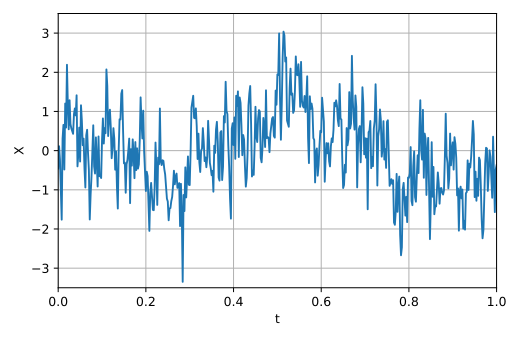
- Pink noise (pictured): A type of noise that has equal energy per octave and can create a more natural-sounding noise, like wind or ocean waves. It can be used to develop a sense of movement or to add depth to a sound.
- Brown noise: A type of noise that has more energy at lower frequencies and less energy at higher frequencies. It can create a sense of warmth or add a low-frequency rumble to a sound.
- Blue noise: A type of noise that has more energy at higher frequencies and less energy at lower frequencies. It can be used to add brightness or sharpness to a sound.
- Violet: Has more energy at the highest frequencies and less energy at the lower frequencies, similar to Blue noise but even more accentuated.
- Grey noise: A type of noise that has equal energy across all frequencies but with the amplitude of each frequency band being inversely proportional to the frequency, similar to pink noise but with a more gradual slope.
- Other types of noise, such as band-pass noise, filtered noise, gated noise, and more, can also be genera
 Synthesizer Online