
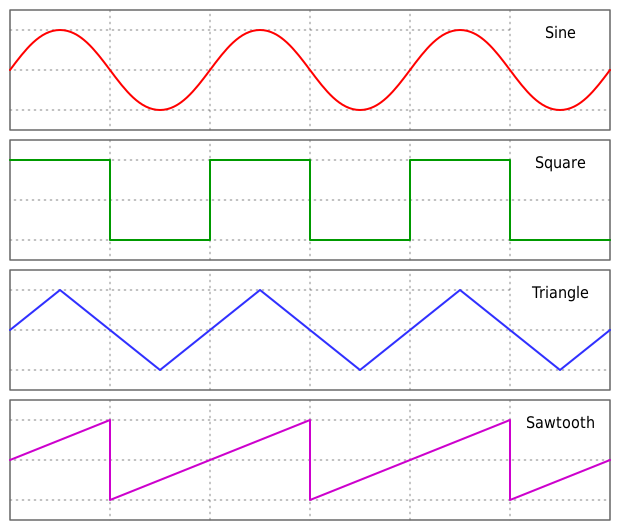
There are several different types of waveforms that can be used in synthesizers. The most common waveforms are:
- Sine wave: A smooth and pure waveform that has no harmonics and is characterized by its gentle, rounded shape. It is often used as a basic waveform for creating simple and classic synth sounds.
- Triangle wave: A waveform that has only odd harmonics and is characterized by its sharp and triangular shape. It is often used to create bell-like and metallic sounds.
- Sawtooth wave: A waveform that has all harmonics and is characterized by its saw-like shape. It is often used to create bright and cutting sounds and it is widely used in leads and bass sounds.
- Square wave: A waveform that has only odd harmonics and is characterized by its square shape. It is often used to create percussive and plucky sounds.
- Pulse wave: A waveform that is similar to a square wave but with the ability to adjust the duty cycle, meaning the proportion of time the waveform is at its peak level to the time it’s at the lowest level. It can create a wide range of sounds depending on the duty cycle adjustment.
- Noise: A random, unpitched audio signal that can be used as a sound source for percussive and experimental sounds
- Sample: A sound that has been recorded, digitized and stored in the synthesizer’s memory. It can be played back as an oscillator, it can be a wide range of sounds like drums, vocals, pianos, etc.
 Synthesizer Online