Categories
Uncategorized

Arturia

Arturia is a French company that was founded in 1999 by Frédéric Brun and Gilles Pommereuil. The company is known for its software synthesizers and other music production tools that are inspired by classic analog synthesizers.

In the early days, Arturia focused on developing software emulations of classic analog synthesizers, such as the Moog Modular, the Minimoog, and the ARP 2600. These emulations, called “virtual instruments,” were designed to accurately replicate the sound and behavior of the original hardware synthesizers and were intended to provide musicians with access to the classic sounds of these instruments without the need to purchase and maintain the original hardware.

In 2007, Arturia released their first hardware synthesizer, the Origin, which was a modular synthesizer that combined the company’s software emulations with physical controllers.

In the following years, Arturia continued to develop and release new software and hardware synthesizers, including the popular Mini V, the Analog Experience, and the KeyLab series of keyboard controllers.

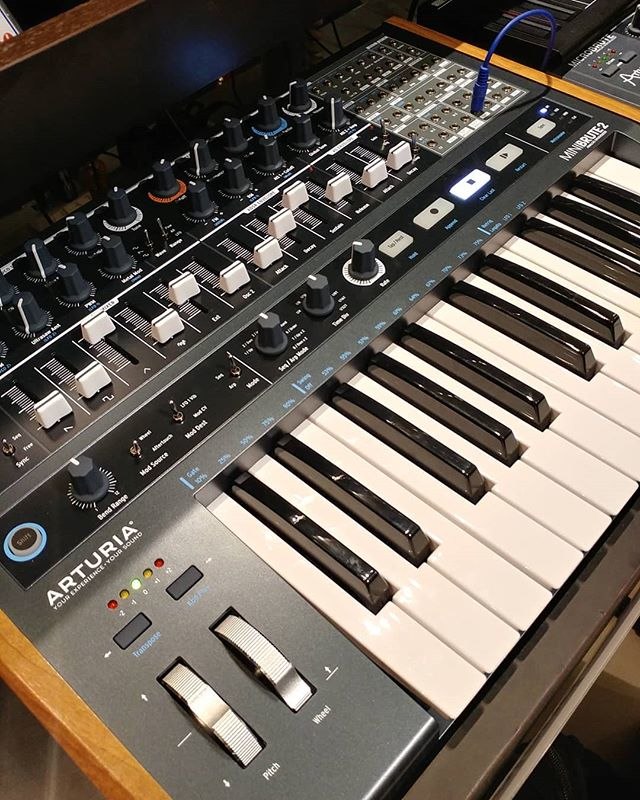
In 2013, Arturia released the MiniBrute (pictured), which was a compact, affordable, and versatile analog synthesizer that quickly became popular among electronic musicians and producers.

Arturia also developed a range of software for music production, including the V Collection, a bundle of virtual instruments that includes emulations of classic synthesizers and other instruments, and the Ableton Live Lite, a free version of the Ableton Live DAW.

Today, Arturia is considered as one of the leading companies in the field of software and hardware synthesizers, and continues to release new and innovative products that blend the vintage sounds of classic analog synthesizers with modern technology.

Categories
Synthesizer Manufacturers

Access Music

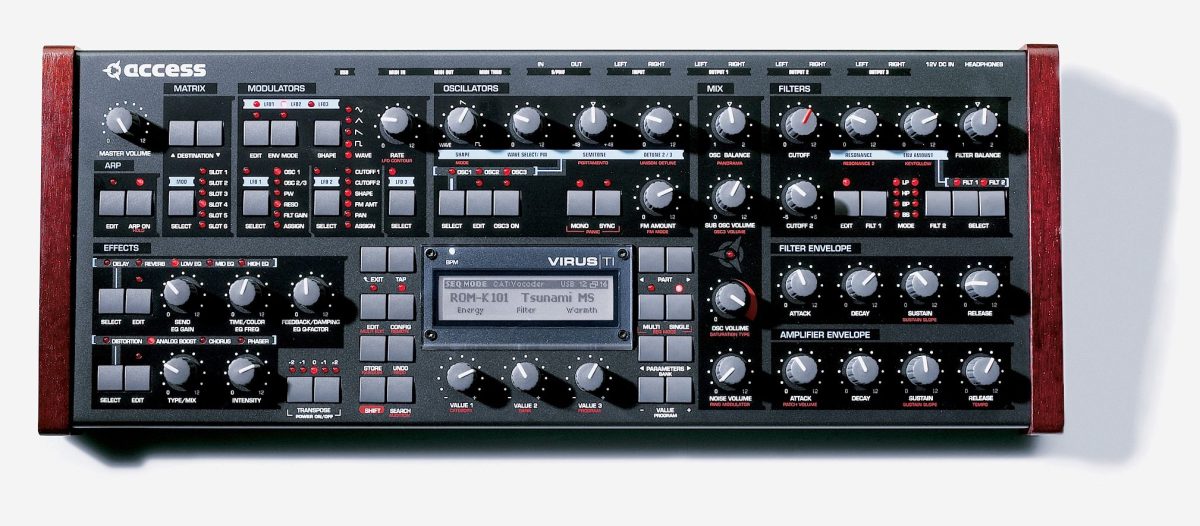
Access Music is a German company that was founded in 1997 by a group of engineers and musicians. They are known for their virtual analog synthesizers, specifically the Virus series. The company’s flagship synthesizer, the Virus TI, was first introduced in 2005, and since then it has become one of the most popular synthesizers in the industry.

Access Music started as a software company, developing software synthesizers for the PC and Mac. Their first product was a software synthesizer called the “Virus” which was released in 1997. The Virus was notable for its unique sound engine that combined the warmth of analog with the precision of digital, and it quickly became a hit among electronic musicians.

In the following years, Access Music continued to develop and improve the Virus software synthesizer, releasing several updates and new versions. They also developed several other software synthesizers and virtual instruments.

In 2005, Access Music introduced the Virus TI, their first hardware synthesizer. This was a major step for the company, and the Virus TI was an instant success. It was a powerful and versatile synthesizer that was capable of producing a wide range of sounds and was well-suited for both live performance and studio work.

Since then, Access Music has continued to develop and improve the Virus TI, releasing several new versions and updates. They also introduced a compact version of the Virus TI called the Virus TI2 and also a desktop version called the Virus TI Snow.

Access Music has been praised for its innovative and high-quality synthesizers and has established a reputation as a leading manufacturer of virtual analog synthesizers. They continue to be a popular choice among electronic musicians and producers for their powerful sound engines and versatile capabilities.

Categories
Synthesizer Manufacturers

Yamaha

Yamaha is a Japanese multinational corporation that has been involved in the design and manufacture of synthesizers for over four decades. The company’s first synthesizer, the Yamaha GX-1, was released in 1973. Since then, Yamaha has produced a wide range of synthesizers, from early analog models to modern digital instruments, and has become one of the most well-known and respected manufacturers of synthesizers in the world.

Yamaha’s first synthesizer, the GX-1, was released in 1973 and was considered to be one of the most advanced and powerful synthesizers of its time. The GX-1 featured a massive array of oscillators, filters, and other sound-generating and processing modules, and it was capable of producing a wide range of sounds. The GX-1 was used by a number of notable musicians, including Keith Emerson of Emerson, Lake & Palmer and Rick Wakeman of Yes.

In the late 1970s and early 1980s, Yamaha released a series of affordable and portable synthesizers, such as the CS-series and the DX-series. The CS-series, like the CS-80, was a polyphonic synthesizer that featured a unique playing interface and was capable of producing a wide range of sounds. The DX-series, like the DX7, was a digital synthesizer that used frequency modulation (FM) synthesis, which was a new technique that allowed for the creation of complex and dynamic sounds. The DX7 was a commercial success and was widely used in pop, rock, and electronic music.

In the 1990s, Yamaha continued to release new synthesizers, including the SY-series and the AN-series. The SY-series, like the SY99, was a digital synthesizer that used advanced synthesis techniques and was widely used by professional musicians and composers. The AN-series, like the AN1x, was an analog-modeling synthesizer that used digital signal processing to emulate the sound of classic analog synthesizers.

In the 21st century, Yamaha has released a number of new synthesizers, including the Motif series, the Montage series, and the MODX series. The Motif series, like the Motif XF, was a powerful workstation synthesizer that featured a wide range of sounds and advanced performance features. The Montage series, like the Montage 8, was a flagship synthesizer that featured advanced sound generation and processing capabilities, as well as a wide range of performance features. The MODX series, like the MODX8, is a lightweight, portable and powerful synthesizer that offers a wide range of sound and performance features.

Categories
Uncategorized

Buchla

The Buchla synthesizer company was founded by electronic instrument pioneer Don Buchla in 1963. The company was based in Berkeley, California and was one of the first companies to design and manufacture modular synthesizers. The Buchla synthesizer company was a pioneer in the field of electronic music, and its instruments were used by a wide range of musicians, composers and sound designers.

The Buchla 100, which was released in 1963, was one of the first electronic instruments to use a modular design. This means that the synthesizer was made up of a series of individual modules that could be connected together to create different sound-generating and processing configurations. This approach was in stark contrast to the traditional keyboard-based synthesizers that were popular at the time, which had a fixed architecture and were not as flexible in terms of sound design.

In the following years, Buchla released several other models, such as the 200 series, which was released in the 1970s and featured a more comprehensive set of modules and expanded capabilities. The Buchla 200 series was widely adopted by composers, musicians, and sound designers, and it became one of the most popular instruments in the field of electronic music.

In the 1980s, Buchla released the Buchla Easel, a portable version of the 200 series that was designed for live performance. The Easel was well received by musicians and performers, and it was used in a wide range of live electronic music performances.

In the 1990s, the Buchla company struggled financially and was forced to close its doors. Don Buchla continued to design and manufacture Buchla-branded instruments under the name Buchla & Associates, but production was limited.

In the 2000s, Buchla & Associates was acquired by a new company, Buchla Electronic Musical Instruments (BEMI), which was formed by a group of former Buchla employees and supporters. BEMI reintroduced the Buchla 200 series, and also released new models such as the Buchla Music Easel and the Buchla Lightning.

Don Buchla passed away in 2016, and the company Buchla Electronic Musical Instruments continues to produce and design Buchla-branded instruments, maintaining the legacy and the innovation of the original Buchla synthesizer company.

Important models

Categories
Classic Synthesizers Synthesizer Models

Buchla 100

The Buchla 100 is a modular synthesizer developed and designed by electronic instrument pioneer Don Buchla in the 1960s. The Buchla 100 is considered to be one of the first modular synthesizers ever created, and it has since become a legendary instrument in the world of electronic music.

The Buchla 100 was created in 1963, and it was one of the first electronic instruments to use a modular design. This means that the synthesizer is made up of a series of individual modules that can be connected together to create different sound-generating and processing configurations. This approach was in stark contrast to the traditional keyboard-based synthesizers that were popular at the time, which had a fixed architecture and were not as flexible in terms of sound design.

The Buchla 100 featured a unique set of modules, including oscillators, filters, and envelope generators, that were specifically designed for the creation of electronic sounds. One of the most notable features of the Buchla 100 was its use of a touch-sensitive keyboard, known as the “Buchla Touch-Sensitive Keyboard,” which was designed to provide more expressive control over the sound. It also featured a set of Voltage Controlled Amplifiers (VCA), Voltage Controlled Filters (VCF), and Voltage Controlled Oscillators (VCO) that allowed for precise control over the sound.

The Buchla 100 was also notable for its use of a unique control voltage system, which was used to control the various modules in the synthesizer. This system used a series of knobs and switches to control the different parameters of the modules, such as frequency, amplitude, and envelope shape.

The Buchla 100 was used by a number of notable musicians and composers in the 1960s and 1970s, including electronic music pioneer Morton Subotnick, who composed several influential works for the instrument. The Buchla 100 was also used by other notable musicians such as Stevie Wonder, and composer and electronic musician Suzanne Ciani.

Despite its groundbreaking design and features, the Buchla 100 was not as commercially successful as its main rival, the Moog synthesizer. However, it has since gained a cult following among electronic music enthusiasts and has been used on a wide range of recordings, from experimental electronic music to pop and rock.

Categories
Classic Synthesizers Synthesizer Models

Moog Prodigy

The Moog Prodigy is a classic synthesizer first introduced in 1979 by Moog Music. It was designed as a more affordable and compact alternative to Moog’s larger and more expensive synthesizers, such as the Minimoog and the Polymoog. Despite its smaller size and lower price point, the Prodigy still featured many of the same powerful sound-generating capabilities as its larger counterparts.

The Prodigy’s sound-generating capabilities are based on Moog’s classic subtractive synthesis architecture. This architecture uses a voltage-controlled oscillator (VCO) to generate a basic waveform, such as a sawtooth or square wave. This waveform is then passed through a voltage-controlled filter (VCF) and a voltage-controlled amplifier (VCA) to shape and control the final sound. The Prodigy also features a noise generator, a sample-and-hold module, and a modulation section that includes a low-frequency oscillator (LFO) for creating vibrato and other modulation effects.

One of the Prodigy’s most notable features is its compact and portable design. The Prodigy’s compact size and lightweight construction made it ideal for musicians on the go, and its relatively low price point made it more accessible to a wider range of musicians than Moog’s larger and more expensive synthesizers. Despite its compact size, the Prodigy still featured a full-sized keyboard and a comprehensive control panel, allowing musicians to easily access and manipulate all of the synth’s various sound-generating capabilities.

The Prodigy was well-received by musicians and critics when it was first released. It was used by many musicians across different genres, from electronic and experimental musicians to pop and rock bands. Some notable musicians that used the Prodigy include Depeche Mode, New Order, and Ultravox.

Despite its popularity, the Moog Prodigy was only produced for a few years and was discontinued in the early 1980s. However, its legacy lives on, and the Prodigy remains a popular and highly sought-after synthesizer among vintage synth enthusiasts and collectors.

Used by

Categories
Uncategorized

Sample-and-hold

Sample-and-hold (S/H) is a function found in some synthesizers that allows the user to sample an input signal, such as an audio or control voltage, and hold the value for a certain period of time. This creates a kind of “snapshot” of the input signal, which can then be used to control various parameters of the synthesizer, such as the pitch or amplitude of the sound.

The process of sample-and-hold typically involves three stages: sampling, holding, and output. During the sampling stage, the input signal is captured and converted into a digital value. In the holding stage, the value is stored and held until the next sample is taken. Finally, in the output stage, the stored value is used to control various parameters of the synthesizer.

Sample-and-hold can be used to create a variety of different effects, such as randomizing the pitch or amplitude of the sound, creating repeating patterns in the sound, or creating complex modulations. It is also commonly used to create the “stuttering” or “glitchy” effects that are often heard in electronic music.

See also

Categories
Classic Synthesizers Synthesizer Models

Moog Polymoog

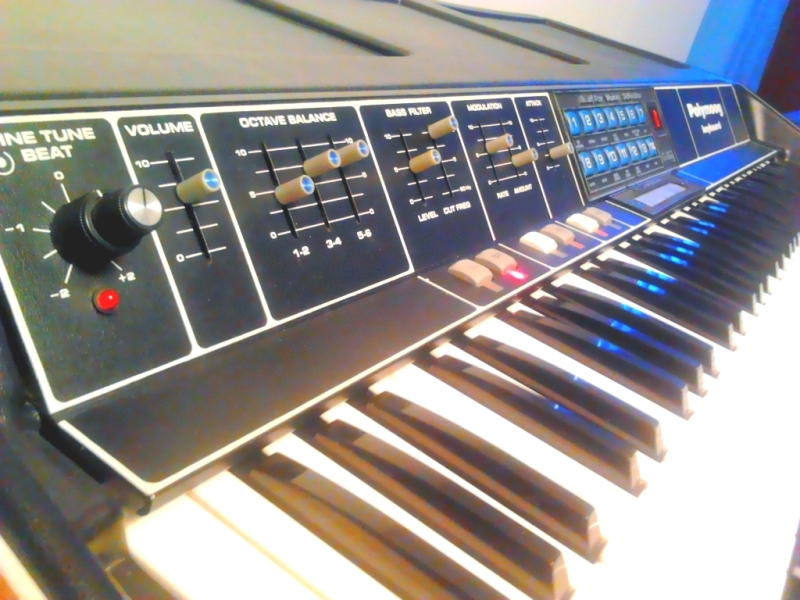
The Polymoog is a polyphonic analog synthesizer manufactured by Moog Music in the 1970s. It was one of the first polyphonic synthesizers available to musicians and was known for its rich, expressive sound and versatility.

The Polymoog was first introduced in 1975 as a follow-up to the popular Minimoog monophonic synthesizer. The Polymoog featured a 71-note weighted keyboard and was capable of producing up to six voices simultaneously, making it a popular choice for musicians who wanted to add a more complex and dynamic sound to their music.

One of the key features of the Polymoog was its use of filtering, which allowed users to shape the synth’s sound in various ways. The synth featured a 24dB/octave resonant low-pass filter, which could be used to create a wide range of sounds, from subtle to extreme. Additionally, the Polymoog featured a 3-band equalizer, which allowed users to adjust the balance of bass, midrange, and treble frequencies.

The Polymoog also featured a variety of modulation sources, including an LFO, a sample-and-hold generator, and an envelope generator. These tools allowed users to add movement and variation to their sounds, creating a wide range of textures and effects.
The Polymoog’s sound generation was based on subtractive synthesis and featured a voltage-controlled oscillator. The Polymoog also featured a noise generator, which could be used to add percussive or other natural sounds to the synth’s sound palette.

Despite its popularity, the Polymoog was in production for only a few years, and production was halted in 1980. However, the Polymoog has become a cult classic and is still highly sought-after by synth enthusiasts today. Its rich, expressive sound and versatility make it a popular choice for musicians looking to add a unique and dynamic sound to their music.

Used by:

Categories
Classic Synthesizers Synthesizer Models

PPG Wave

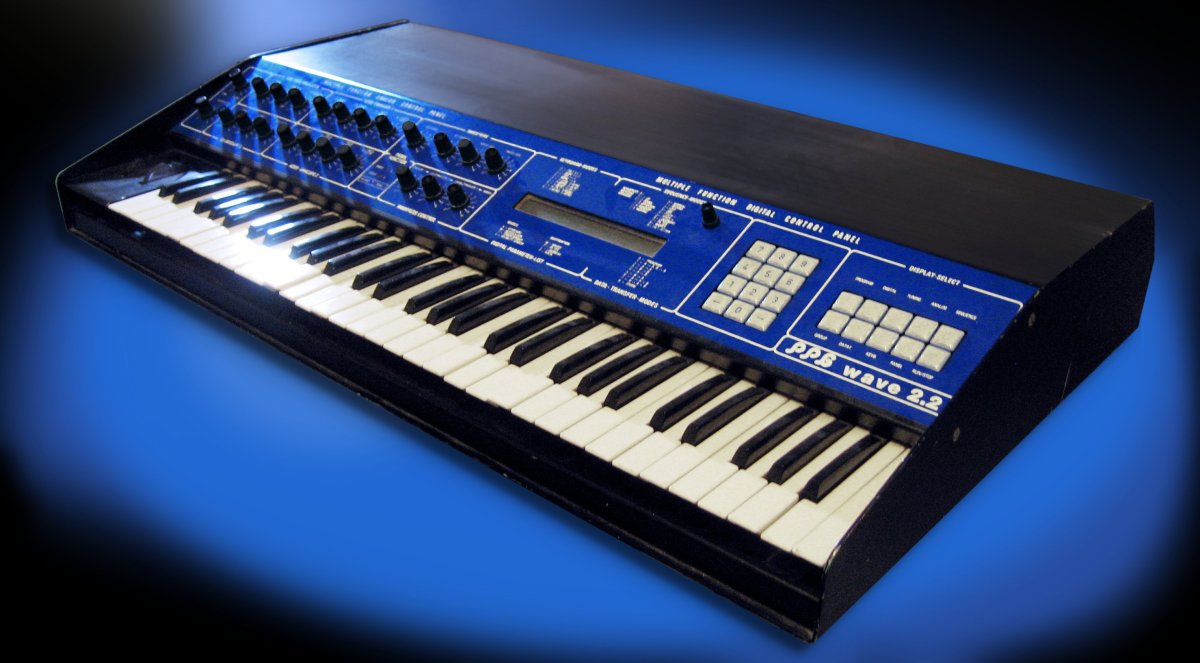
The PPG Wave synthesizer, also known as the Wavecomputer, was a digital synthesizer developed by the German company PPG (Palm Products GmbH) in the 1980s. The instrument was distinguished by its distinctive tone, which was produced by combining additive and wavetable synthesis methods.

With the debut of the PPG Wave 2.2 in 1981, the PPG Wave was first made public. This model has a 61-note keyboard and an integrated 8-track sequencer. Many well-known bands, including Tangerine Dream, Pet Shop Boys, and Depeche Mode, utilized the instrument. Musicians in the electronic and experimental music genres soon welcomed it.

The PPG Wave’s wavetable synthesis method, which lets users manipulate many single-cycle waveforms to produce complex and changing sounds, was one of its standout features. The device also has a variety of built-in waveforms, such as sine, square, and sawtooth waves, as well as some more complex waveforms, such as formants and noise.

The PPG Wave’s ability to perform additive synthesis was another noteworthy aspect. This method allows users to combine several sine waves with various frequencies and amplitudes to produce sounds. This made it possible to create sounds that were even more intricate and nuanced than with only wavetable synthesis.

The PPG Wave had a variety of valuable features in addition to its synthesis capabilities, including an arpeggiator, a built-in chorus effect, and numerous modulation possibilities.

Eventually, the PPG Wave was replaced by the PPG Wave 2.3 and PPG Wave 2.3 Turbo, which had better sound and more memory. The PPG Wave was well-liked by electronic and experimental musicians, but as newer and more sophisticated synthesizers became available in the late 1980s, production of the instrument eventually ceased.

Despite this, the PPG Wave is still regarded as a cult favorite among synth lovers, and its features and sounds are still in high demand.

Used by

  • Tangerine Dream: The German electronic music band was one of the first and most prominent users of the PPG Wave. The band used the instrument on several of their albums, including “Exit” and “Hyperborea.”
  • Pet Shop Boys: The British synthpop duo used the PPG Wave on several of their early albums, including “Please” and “Actually.”
  • Depeche Mode: The British electronic band used the PPG Wave on their album “Black Celebration,” which was released in 1986.
  • Gary Numan: The British musician and pioneer of electronic music used the PPG Wave on his album “The Fury,” which was released in 1985.
  • Jean Michel Jarre: The French electronic musician also used PPG Wave on his album “Zoolook” which was released in 1984.
  • Art of Noise: The British band and pioneers of sample-based music used PPG Wave on their album “In Visible Silence” which was released in 1986
  • New Order: The British band used PPG Wave on their album “Power, Corruption & Lies” which was released in 1983
Categories
Classic Synthesizers Drum Machines Synthesizer Models

Akai MPC

The Akai MPC, or MIDI Production Center, is a series of music production workstations introduced by Akai in 1988. The MPC soon rose to prominence as one of the most widely used and significant tools in the field of electronic music creation.

The original MPC was intended to be an all-in-one music production system. It included a sequencer, a sampler, and a drum machine. The sampler allowed users to record and edit samples, whereas the drum machine allowed users to construct and edit their own drum patterns. Users could record and edit their own tunes using the sequencer, and it could sync with other devices through MIDI.

Music producers and artists found the MPC’s user-friendly interface to make recording and editing music simple. Thanks to the front panel’s many knobs, buttons, and sizable LCD screen, it was simple to access the numerous operations and settings. The MPC also included an integrated effects processor that let users give their samples and drum patterns reverb, delay, and other effects.

Hip-hop, electronic, and pop music, among other musical styles, all frequently employed the MPC. A Tribe Called Quest, Public Enemy, Dr. Dre, and The Prodigy were just a few musicians who utilized it. The MPC was renowned for its capacity to produce lifelike sound effects and orchestral simulations, and it was also employed in film and television soundtracks.

The MPC60, MPC3000, MPC2000, MPC2000XL, MPC4000, MPC5000, MPC Renaissance, MPC Studio, and MPC Live are just a few of the new MPC models that Akai has released over the years. With each subsequent release, more features and functionalities were added, such as increased RAM, storage space, and processing power.

The MPC is still a well-liked and highly sought-after instrument among fans and producers of electronic music today. Since it is still employed in many contemporary performances, its legacy endures. The MPC continues to offer a blend of vintage feel and cutting-edge technology in its most recent iterations, the MPC X, MPC Live, and MPC One, making it a flexible instrument for music production.

With its integration of a drum machine, sampler, and sequencer, the Akai MPC is a music production workstation that transformed the music business. It became a necessary tool for many musicians and producers due to its user-friendly interface, potent sound manipulation capabilities, and extensive feature set. It is still frequently employed in various musical genres and the music production industry, preserving its legacy.

Used by

  • Dr. Dre: The hip-hop producer and rapper used the MPC extensively throughout his career. He used it on his groundbreaking album “The Chronic” (1992) and on many of his other albums.
  • A Tribe Called Quest: The hip-hop group used the MPC on their album “The Low End Theory” (1991).
  • Public Enemy: The hip-hop group used the MPC on their album “Apocalypse 91…The Enemy Strikes Black” (1991).
  • The Prodigy: The electronic group used the MPC on their album “Experience” (1992).
  • The Chemical Brothers: The electronic group used the MPC on their album “Exit Planet Dust” (1995)
  • Goldie: The drum and bass artist used the MPC on his album “Timeless” (1995)
  • J Dilla: The hip-hop producer and rapper used the MPC extensively throughout his career. He used it on many of his productions and solo albums.

  • Madlib: The hip-hop producer and rapper used the MPC extensively throughout his career. He used it on many of his productions and solo albums.
  • Timbaland: The hip-hop producer and rapper used the MPC extensively throughout his career. He used it on many of his productions and solo albums.