
Categories
Common Synthesizer Controls Sound Design and Production Concepts Synthesizer Concepts

Decay

On a synthesizer, decay is the time it takes for the sound to fade from its highest level, determined by the attack stage, to the sustain level. It regulates the amplitude envelope of the sound and is typically found in the envelope section of a synthesizer. The four stages of the amplitude envelope—a graph that depicts how a sound’s volume changes over time—are attack, decay, sustain, and release.

The decay stage, which follows the attack stage in the amplitude envelope, determines how long the sound will fade from its peak level to the sustain level. A sound will diminish more quickly with a shorter decay time than it will more gradually with a longer decay time.

The decay parameter can produce various effects and is particularly helpful for modifying the sound of percussive instruments like drums and plucked instruments. Longer decay times can create more natural and smooth sounds, while shorter decay times can produce sharp and percussive sounds.
Categories
Common Synthesizer Controls Sound Design and Production Concepts Synthesizer Concepts

Attack

Attack on a synthesizer refers to the time it takes for a sound to reach its peak level after a note is played. It regulates the amplitude envelope of the sound and is typically found in the envelope section of a synthesizer. The four stages of the amplitude envelope—a graph that depicts how a sound’s volume changes over time—are attack, decay, sustain, and release.

The first stage of the amplitude envelope is the attack stage, which begins when a note is played and determines how long it takes for the sound to reach its peak level. A sound will reach its peak level more quickly with a shorter attack time than with a longer one. A sound will reach its peak level more gradually.

The attack parameter can produce various effects and is particularly helpful for modifying the sound of percussion instruments, such as drums and plucked instruments. While a longer attack time can be used to produce a more gradual and smooth sound, a shorter attack time can be used to produce a sharp and percussive sound.

Categories
Sound Design and Production Concepts

Waveforms

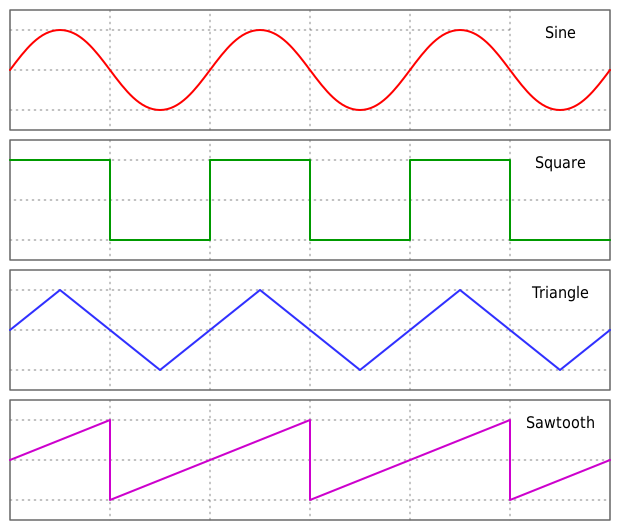
There are several different types of waveforms that can be used in synthesizers. The most common waveforms are:

  1. Sine wave: A smooth and pure waveform that has no harmonics and is characterized by its gentle, rounded shape. It is often used as a basic waveform for creating simple and classic synth sounds.
  2. Triangle wave: A waveform that has only odd harmonics and is characterized by its sharp and triangular shape. It is often used to create bell-like and metallic sounds.
  3. Sawtooth wave: A waveform that has all harmonics and is characterized by its saw-like shape. It is often used to create bright and cutting sounds and it is widely used in leads and bass sounds.
  4. Square wave: A waveform that has only odd harmonics and is characterized by its square shape. It is often used to create percussive and plucky sounds.
  5. Pulse wave: A waveform that is similar to a square wave but with the ability to adjust the duty cycle, meaning the proportion of time the waveform is at its peak level to the time it’s at the lowest level. It can create a wide range of sounds depending on the duty cycle adjustment.
  6. Noise: A random, unpitched audio signal that can be used as a sound source for percussive and experimental sounds
  7. Sample: A sound that has been recorded, digitized and stored in the synthesizer’s memory. It can be played back as an oscillator, it can be a wide range of sounds like drums, vocals, pianos, etc.
Categories
Sound Design and Production Concepts

Amplitude

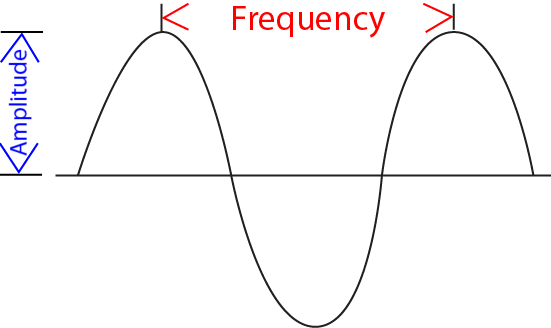
On a synthesizer, the amplitude is the term used to describe the overall level or volume of the sound being produced. It can be adjusted using a fader or knob and is typically expressed in decibels (dB).

Depending on the synth, the amplitude can be controlled at the oscillator level, the envelope generator level, the mixer level, or the output level during various stages of sound production.

A patch can have different loudness levels for each oscillator by using amplitude to control the volume of each oscillator at the oscillator level. Amplitude is managed at the envelope generator level by the envelope generator, which modifies the sound’s amplitude over time. The attack, decay, sustain, and release stages of the envelope generator are all where the amplitude is controlled.

After all the oscillators have been blended, amplitude controls the overall volume of the sound at the mixer level. This is useful for balancing the levels of various components in a patch. Amplitude on the output level regulates the sound’s final volume before it is sent to the synth’s output, which is useful for adjusting the sound’s overall loudness.

See also

Categories
Sound Design and Production Concepts

Frequency

Frequency on a synthesizer refers to the number of times a waveform oscillates within one second, measured in hertz (Hz). It is a parameter that governs the pitch of the sound being produced and is located on the oscillator section of a synthesizer.

In a synthesizer, each oscillator has a frequency control that enables the user to adjust the oscillator’s pitch concerning a musical scale. A synth’s frequency can be set to a specific number, such as 440Hz, which is the pitch of the note A in standard tuning, or to a particular note, such as “A4”, which is also tuned to 440Hz. Some synths, such as those with a pitch bend wheel or a pitch modulation control, let the user set the frequency more flexibly.

One of the critical factors determining how a synth sounds are its oscillator’s frequency, which is used to produce a wide variety of sounds. Higher frequencies produce higher-pitched sounds, while lower frequencies produce sounds with a lower pitch. Furthermore, real-time frequency modulation enables the creation of dynamic and expressive changes in the sound. This can create various effects, including vibrato, pitch bends, and other modulation types, and it can be done by using an LFO or an envelope generator.

See also:

Categories
Sound Design and Production Concepts

Harmonics

Harmonics in a synthesizer are the additional frequencies that are present in a sound, in addition to the fundamental frequency. The harmonics are the integer multiples of the fundamental frequency, which is the base frequency of a sound.

An oscillator in a synthesizer typically combines the fundamental frequency with a number of harmonics to produce a sound. These harmonics, which can be viewed as overtones or partials, are responsible for the sound’s distinctive timbre or tone. Different harmonics exist in each waveform, and the harmony between them gives each waveform its personality.

For instance, a square wave only has odd harmonics, while a sawtooth wave has all the harmonics. A sine wave only has the fundamental frequency.

A filter, a common component of many synthesizers, can modify the presence and balance of harmonics. Filters allow users to increase or decrease specific harmonics, which can be used to shape the sound and produce a wide variety of timbres. In addition, some synths have a harmonics control that enables the user to add or remove harmonics from the waveform, allowing for the creation of various waveform variations and new sounds.

Categories
Sound Design and Production Concepts

Timbre

Timbre, also referred to as tone color or sound quality, describes the distinctive attributes of a sound that set it apart from other sounds. The waveform of the oscillator, the cutoff and resonance settings for the filter, the envelope settings, and any effects that have been applied to the sound all contribute to the timbre of a synthesizer.

The harmonic content and relationship of the harmonics to the fundamental frequency of a sound influence its timbre. Each waveform has a distinct harmonic composition, and how these harmonics are balanced gives each waveform its personality. For instance, a sine wave has a highly pure and smooth timbre, whereas a sawtooth wave has a brighter and more complex timbre.

The waveform greatly influences the timbre of a sound in addition to the filter settings. Specific harmonics can be amplified or suppressed using the filter cutoff and resonance settings, which can be utilized to produce a wide variety of timbres. The envelope parameters can also be used to alter the attack, decay, sustain, and release of a sound, affecting the sound’s timbre.

The timbre of a sound can also be shaped using a variety of effects, including reverb, delay, and distortion. These effects can produce a broad array of timbres and give a sound depth, dimension, and character.