
Categories
Sound Design and Production Concepts Synthesizer Concepts

Phase Distortion Synthesis (PDS)

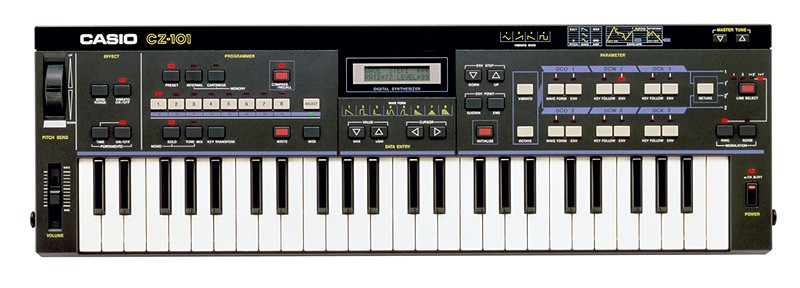
Phase Distortion Synthesis (PDS) is a technique for creating sounds that are used in creating electronic music, particularly in the mid-1980s Casio CZ synthesizers. The method, which is based on changing a waveform‘s phase, gives users more control over a sound’s harmonic composition. This makes it possible to produce a wider variety of sounds than traditional subtractive synthesis.

By changing the phase of a fundamental waveform, typically a sine wave, PDS produces sound by generating a new waveform with new harmonic content. Complex sounds that would be challenging or impossible to create using conventional subtractive synthesis can be produced by manipulating the waveform’s phase.

One of PDS’s main benefits is that it makes it possible to produce sounds with a variety of harmonic content. Bass, leads, and percussive sounds can all be produced this way. Additionally, it enables the production of intricate and changing sounds that are challenging to achieve using conventional subtractive synthesis.

PDS also offers extensive control over a sound’s harmonic composition, which can be used to produce unusual and distinctive sounds. This has led to it becoming a well-liked option for musicians and producers looking to incorporate unique and distinctive sounds into their music.

In general, phase distortion synthesis is a robust and adaptable method of sound creation that can create a variety of sounds. It has become a popular option among musicians and producers looking to produce distinctive and one-of-a-kind sounds. It is still used today in many types of electronic music production.

Categories
Sound Design and Production Concepts Synthesizer Concepts

Wavetable

A wavetable is a group of sound samples stored digitally and used as the foundation for wavetable synthesis in synthesizers. It is a table of values that creates a digital representation of a waveform by representing the amplitude of a sound at various points in time. This waveform could be a straightforward sine wave or a more complex sound, like an instrument recording or a soundscape.

Wavetable synthesis uses the samples in the wavetable as the starting point for creating new sounds and uses wavetables. An oscillator that can be modulated to produce different sounds reads the wavetable. For instance, the index can be modulated to move through the wavetable at different rates, changing the harmonic content and overall character of the sound. The oscillator’s frequency can also alter the sound’s pitch.

In summary, a wavetable is a group of sound samples that can be used as the foundation for sound synthesis using wavetable synthesis and is stored in a digital format. It can be modulated to produce various sounds and read by an oscillator to generate a sound.

Categories
Common Synthesizer Controls Sound Design and Production Concepts Synthesizer Concepts

Release

Release on a synthesizer refers to the amount of time it takes for a sound to fade out after a note is released. This parameter is typically found in the envelope section of a synthesizer, and it controls the amplitude envelope of the sound. The amplitude envelope is a graph that shows how the volume of a sound changes over time, and it is divided into four stages: attack, decay, sustain, and release.

The release stage is the final stage of the amplitude envelope, and it starts when a note is released, and it controls how long it takes for the sound to fade out after the note is released. A shorter release time will result in a sound that fades out quickly, while a longer release time will result in a sound that fades out slowly.

The release parameter is particularly useful for shaping the sound of sustained instruments such as pianos, strings and horns, and can be used to create a wide range of different effects. A short release time can be used to create a sharp and percussive sound, while a longer release time can be used to create a more natural and smooth sound. Additionally, Release can be used to create interesting sound effects like a “staccato” sound or a “legato” sound.

Categories
Common Synthesizer Controls Sound Design and Production Concepts Synthesizer Concepts

Decay

On a synthesizer, decay is the time it takes for the sound to fade from its highest level, determined by the attack stage, to the sustain level. It regulates the amplitude envelope of the sound and is typically found in the envelope section of a synthesizer. The four stages of the amplitude envelope—a graph that depicts how a sound’s volume changes over time—are attack, decay, sustain, and release.

The decay stage, which follows the attack stage in the amplitude envelope, determines how long the sound will fade from its peak level to the sustain level. A sound will diminish more quickly with a shorter decay time than it will more gradually with a longer decay time.

The decay parameter can produce various effects and is particularly helpful for modifying the sound of percussive instruments like drums and plucked instruments. Longer decay times can create more natural and smooth sounds, while shorter decay times can produce sharp and percussive sounds.

Categories
Common Synthesizer Controls Sound Design and Production Concepts Synthesizer Concepts

Attack

Attack on a synthesizer refers to the time it takes for a sound to reach its peak level after a note is played. It regulates the amplitude envelope of the sound and is typically found in the envelope section of a synthesizer. The four stages of the amplitude envelope—a graph that depicts how a sound’s volume changes over time—are attack, decay, sustain, and release.

The first stage of the amplitude envelope is the attack stage, which begins when a note is played and determines how long it takes for the sound to reach its peak level. A sound will reach its peak level more quickly with a shorter attack time than with a longer one. A sound will reach its peak level more gradually.

The attack parameter can produce various effects and is particularly helpful for modifying the sound of percussion instruments, such as drums and plucked instruments. While a longer attack time can be used to produce a more gradual and smooth sound, a shorter attack time can be used to produce a sharp and percussive sound.

Categories
Synthesizer Concepts

Patches

A synthesizer patch is a collection of settings defining the sound a synthesizer produces. The oscillator‘s waveform, frequency, amplitude, cutoff and resonance, the settings for the envelope, and any sound effects are some examples of these settings.

A patch can be viewed as a memory of all the settings necessary to produce a particular sound. The user’s ability to save and retrieve patches enables them to easily switch between various sounds without constantly tweaking all the settings.

The user can combine related sounds by using banks, frequently used to arrange patches. For instance, a user might make a bank of patches appropriate for techno music, while another bank might have patches appropriate for ballads.

Additionally, by changing the synthesizer’s parameters, many synthesizers let the user generate unique patches. A user can produce their own distinctive sounds in this way and save them as patches for later use.

Categories
Synthesizer Concepts

Samples

Samples in electronic music are small segments of audio that have been recorded, digitized, and stored in a computer or electronic device. These samples can be utilized in many ways, such as to make loops and new sounds or give a track texture and intrigue.

Making loops is one of the most popular uses of samples in electronic music. A loop is a section of audio played repeatedly and can serve as the basis for a track. Drums, basslines, melodies, and other elements can all be sampled and used to create loops. A producer can make a complex and dynamic track by altering and overlaying many loops.

Additionally, new sounds can be produced using samples. For instance, a sample of a guitar sound can be altered and processed to create an entirely different sound from the original sample. Samples can also be merged and layered to add different textures and add interesting details to a track.

Additionally, samples can be used as a sound source in a synthesizer using “sampling synthesis,” a process that involves using the sample as an oscillator to produce new sounds.

Categories
Synthesizer Concepts

Digital Signal Processing (DSP)

Digital Signal Processing (DSP) is a method of manipulating and processing audio signals using digital computers or specialized digital signal processors. DSP can be used in a synthesizer to produce a large variety of sounds and effects, including filtering, modulation, and distortion. Digital versions of classic analog effects like reverb and delay can be produced using DSP algorithms, as can new and distinctive sounds that are impossible with analog synthesis.

For instance, DSP can also be used to design intricate modulation routings and sophisticated envelopes in a synthesizer’s control section. DSP can be used to produce expressive and responsive sound synthesis when combined with MIDI data. Large memory capacities are another feature of DSP-based synthesizers that enable the creation of more intricate and detailed sound programs and the simple storage, recall, and editing of sound parameters.

Categories
Synthesizer Concepts

Polyphonic

Categories
Synthesizer Concepts

Monophonic