Categories
Synthesizer Features

Aftertouch

Aftertouch in a synthesizer is a feature that allows the player to add expression to a sound by applying pressure to a key after it has been struck. Additionally, it is referred to as “channel pressure” or “monophonic pressure.” Aftertouch comes in two flavors: monophonic and polyphonic.

All the keys simultaneously receive monophonic aftertouch, meaning that pressing one key will impact all the notes being played at that moment. The filter cutoff or vibrato depth are two examples of single parameters that are frequently controlled by this kind of aftertouch.

On the other hand, polyphonic aftertouch enables the player to apply pressure to specific keys, allowing each key to affect a different parameter. This enables more expressive and nuanced playing. Given that it requires more complicated hardware to implement, monophonic aftertouch is rare.

Aftertouch can be used to control the vibrato depth, amplitude, and filter cutoff in a synthesizer, among other parameters. Additionally, it can be designated to manage extraneous gadgets like effects processors or other synthesizers. It’s a feature that gives the player more freedom of expression and control, enabling them to sculpt the sound in novel ways.

Not all synthesizers have aftertouch; it is more frequently found in expensive, professional-grade instruments and requires more complicated hardware. Many professional musicians and performers want it, but it’s not a standard feature in most MIDI controllers.

Categories
Synthesizer Features

Velocity Sensitivity

Velocity sensitivity in a synthesizer refers to the ability of the instrument to respond to the speed at which a key is struck. A key strike’s velocity is frequently expressed in MIDI (Musical Instrument Digital Interface) values, which range from 0-127. A velocity-sensitive synthesizer’s corresponding MIDI value will be lower when a key is played softly and higher when the key is played harder.

A velocity-sensitive synthesizer can use this knowledge to modify the sound’s volume, timbre, and attack. When a velocity-sensitive synthesizer is used to control the volume, pressing a key lightly will produce a quieter sound, while pressing it firmly will make a louder sound. As a result, playing can be more expressive, and the instrument may appear more lively and responsive to the player’s touch.

Electronic keyboards and synthesizers frequently have velocity sensitivity, and most professional-grade MIDI controllers come equipped with it as standard. It can play a significant role in a synth’s expressive potential by granting the user greater control over the dynamics and articulation of the sound.

Categories
Sound Design and Production Concepts Synthesizer Features

Voices

A voice in a synthesizer is a standalone sound-generating or sound-processing unit that can create sounds independently. How many sounds a synthesizer can produce at once is determined by the number of voices it has.

For instance, a synthesizer with four voices can simultaneously produce four different sounds. This can be used to play multiple notes simultaneously, such as when playing a melody, or to create complex and layered sounds, such as chords.

One can also refer to a synthesizer as polyphonic if it has several voices. Monophonic refers to a synthesizer that can only play one note at a time. It is possible to switch between monophonic and polyphonic modes on some synthesizers.

Depending on the synthesis technique it employs, a synthesizer can produce a variety of voices. Oscillators, filters, and envelopes make up the voices of some subtractive synthesis synthesizers. Some people create voices using wavetable synthesis, which uses wavetables, filters, and envelopes. Granular synthesis is a synthesizer in which the voices are composed of grains, filters, and envelopes.

Additionally, some synthesizers have features like voice layering, voice stacking, and voice splitting that let you use multiple voices in various ways. For instance, you could layer various sounds to create complex timbres or divide the keyboard into different zones and assign multiple sounds to each zone.

Generally, a synthesizer’s capabilities and the types of sounds it can create depend on the number of voices it has and the voices it employs. These factors should be taken into account when selecting a synthesizer.

Categories
Common Synthesizer Controls Synthesizer Features

MIDI (Musical Instrument Digital Interface)

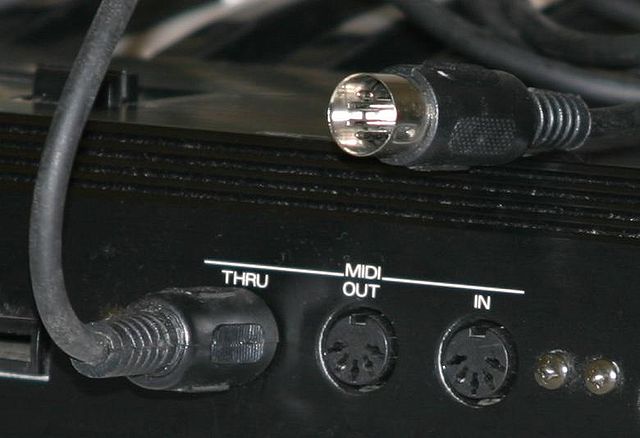
MIDI (Musical Instrument Digital Interface) is a technical standard that allows electronic musical instruments, computers, and other devices to communicate and synchronize. It is a protocol that allows various devices to communicate with one another and exchange musical data, such as the notes being played and the control settings of a specific instrument or effect.

Digital messages that can control the pitch and velocity of a note, the modulation of a sound, or the beginning and end of a drum loop make up MIDI data, which is sent and received via a MIDI cable or over a wireless connection. Lighting and visual effects can be managed during concerts using MIDI data.

In addition to allowing musicians to easily record, edit, and manipulate MIDI data in a digital audio workstation (DAW) to create intricate and dynamic musical arrangements, MIDI is a potent tool for music production and live performance.

MIDI devices include

  • MIDI keyboard controllers: used to play virtual instruments and control other MIDI-enabled devices.
  • MIDI drum pad controllers: used to trigger drum samples and control other MIDI-enabled devices.
  • MIDI guitar controllers: used to play virtual instruments and control other MIDI-enabled devices.
  • MIDI wind controllers: used to play virtual instruments and control other MIDI-enabled devices.
  • MIDI DJ controllers: used to control DJ software and other MIDI-enabled devices.

Overall, MIDI is a widely adopted and adaptable technology that has significantly increased electronic music’s production and live performance capabilities.

Categories
Synthesizer Features

Frequency Modulation (FM) Synthesizer

An FM (Frequency Modulation) synthesizer is a type of synthesizer that creates sound by modulating the frequency of one oscillator (the carrier) with the output of another oscillator (the modulator). This creates complex, harmonically rich timbres and can be used to create a wide range of sounds, from bell-like tones to metallic and percussive sounds.

In an FM synthesizer, the carrier oscillator generates the basic sound, and the modulator oscillator modifies the frequency of the carrier. The amount of modulation, or the “index” is controlled by the operator, and it determines the amount of harmonic complexity added to the sound. FM synthesis can produce a wide range of sounds, from simple sine waves to complex, evolving timbres.

FM synthesis was first developed by John Chowning in the 1970s, and it was later implemented in commercial synthesizers by Yamaha in the early 1980s. Since then, FM synthesis has been used in a wide variety of music genres, from electronic and pop to jazz and classical.

FM synthesis is known for its ability to create a wide range of sounds, from simple sine waves to complex, evolving timbres. It’s particularly good at creating bell-like, metallic and percussive sounds. FM synthesis can be a little bit more complex to use than other types of synthesis, but it is a very powerful and versatile technique, and it can be used to create a wide range of interesting and unique sounds.

Examples

  • Yamaha DX7: One of the most famous and widely used FM synthesizers, the DX7 was released in 1983 and it was known for its ability to create a wide range of sounds, including bell-like, metallic and percussive sounds. It became very popular in the 1980s, and it was used in a wide variety of music genres.
  • Yamaha DX9: An improved version of the DX7, the DX9 was released in 1985. It offered more features and capabilities than the DX7, including the ability to create more complex sounds.
  • Yamaha DX21: A more affordable version of the DX7, the DX21 was released in 1985. It has a similar sound engine to the DX7 but with a more limited set of features.
  • Korg DS-8: A digital FM synthesizer released by Korg in 1986, the DS-8 was known for its ability to create a wide range of sounds and its user-friendly interface.
  • Casio CZ-series: Casio released a series of affordable and compact FM synthesizers in the 1980s, which were known for their ability to create complex, evolving sounds.
  • Native Instruments FM8: A software FM synthesizer, FM8 is known for its ability to create a wide range of sounds and its user-friendly interface. It also allows for complex modulation and a wide range of presets.
Categories
Synthesizer Features

Subtractive Synthesizer

A subtractive synthesizer is a type of synthesizer that uses filters to subtract harmonics from a waveform to create a desired sound. It begins with a complicated sound, like a sawtooth, square, or noise waveform, and then employs filters to eliminate particular frequencies or harmonics. Because the harmonics are being subtracted from the original waveform, this process is known as “subtraction.”

The low-pass filter is the most typical type used in subtractive synthesis. It attenuates or blocks out higher frequencies while allowing low frequencies to pass through. This kind of synthesis also employs high-pass, band-pass, and band-stop filters. Envelopes also gradually alter the sound’s amplitude and other properties.

One of the most popular synthesis methods in electronic music is subtractive synthesis, which also serves as the foundation for many iconic analog synthesizers like the Moog Minimoog and Roland SH-101.

One of the most flexible sound design techniques is a straightforward and intuitive synthesis method that enables the user to shape and sculpt the sound in various ways.

To produce a desired sound, subtractive synthesis uses filters to remove harmonics from a waveform. It begins with a complicated waveform, like a sawtooth, square, or noise waveform, and then employs filters to eliminate particular frequencies or harmonics. The low-pass filter is the most popular filter used in subtractive synthesis. It is one of the most widely used synthesis techniques in electronic music, is easy to understand, and serves as the foundation for many iconic analog synthesizers.

Examples

Categories
Synthesizer Features

Semi-modular Synthesizers

A semi-modular synthesizer is a type of synthesizer that combines features of both modular and traditional synthesizers. Like a modular synthesizer, a semi-modular synth has a collection of functional modules, such as oscillators, filters, and envelopes, that can be connected together using patch cables. However, unlike a full modular synth, a semi-modular synthesizer usually has a predetermined signal flow or patching, so that the user can produce sound without patching cables.

A semi-modular synthesizer is a compromise between a fully patchable modular synth and a fixed architecture synth. They are a good option for musicians and producers who want to experiment with the possibilities of patching and modular synthesis, but also want to have a more traditional and predictable sound generation mechanism.

Some popular semi-modular synthesizers include the Moog Mother-32, the Make Noise 0-Coast, Arp 2600, and the Pittsburgh Modular Lifeforms.

In summary, a Semi-Modular Synthesizer is a type of synthesizer that combines features of both modular and traditional synthesizers. It has a collection of functional modules, such as oscillators, filters, and envelopes, that can be connected together using patch cables, but also has a predetermined signal flow or patching, so that the user can produce sound without patching cables. It’s a good option for musicians and producers who want to experiment with the possibilities of patching and modular synthesis, but also want to have a more traditional and predictable sound generation mechanism.

Examples

  • Moog Mother-32
  • Make Noise 0-Coast
  • Arp 2600
  • Pittsburgh Modular Lifeforms
Categories
Synthesizer Features

Sampler

A synthesizer sampler is a device or feature found in some synthesizers that allows the user to record and play back audio samples. A sample is a short recording of a sound, such as a piece of music, a spoken word, or a sound effect. The sample can then be played back using the keyboard or other controller, and can be manipulated in various ways, such as changing the pitch, tempo, or looping the sample.

Samplers typically have a variety of features that allow the user to manipulate the samples in a variety of ways. For example, the sample can be pitch-shifted, time-stretched, reversed, or looped. Some samplers also include filters, envelopes, and other synthesis parameters, which can be used to shape and sculpt the sound of the sample.

Samplers are used in a wide variety of music genres, and they have had a significant impact on the development of electronic and hip-hop music, where samples of pre-recorded music are often used as the basis for new compositions. They also have many other applications, such as sound design and sound effects, as well as in live performances.

Modern synthesizers with sampling capabilities allow you to record and manipulate sounds and samples in a variety of ways, and you can use them to create new, unique sounds. They can also be used to create complex and dynamic rhythms, and they can be used to add a new dimension to your music production.

Categories
Synthesizer Features

Vocoder

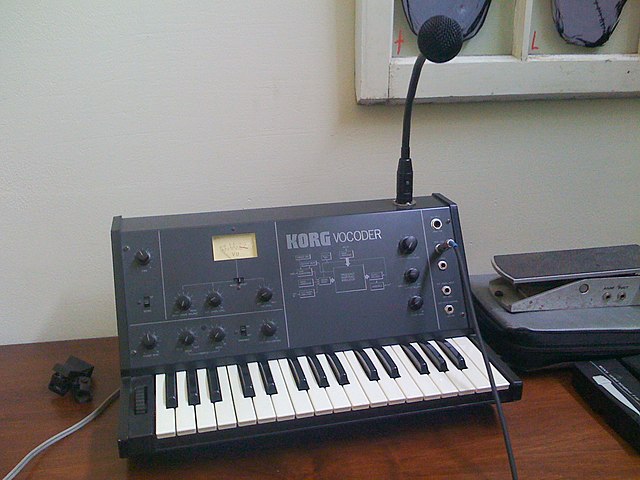
A synthesizer vocoder is a device that combines the sounds of two different signals, a modulator, and a carrier, to create a new, unique sound. The carrier signal is typically a synthesized sound, like a sawtooth or square wave, while the modulator signal generally is an audio recording of a human voice. The vocoder modifies the frequency content of the carrier signal by studying the modulator signal’s frequency content. The end result is a sound that combines the modulator signal’s timbre and intonation with the carrier signal’s harmonic content.

A bank of bandpass filters divides the modulator signal into various frequency bands, producing the vocoder effect. The amplitude of each frequency band then controls the carrier signal’s amplitude. This gives the impression that the words or sounds coming from the modulator signal are being “spoken” by the carrier signal.

The 1930s saw the introduction of the vocoder effect, initially used to compress speech but quickly made its way into music. It gained popularity in the 1970s thanks to the use of robotic and futuristic vocal effects by bands like Kraftwerk and ELO. Vocoders are still frequently used to produce distinctive vocal effects in electronic, pop, and hip-hop music today.

Some synthesizers come with a built-in vocoder, while others can be used to add the vocoder effect using an external microphone. The vocoder can be a potent tool for producing distinctive and intriguing sounds, adding a fresh perspective to the music-making process.

Categories
Synthesizer Features

Arpeggiator (Arp)

Many synthesizers have an arpeggiator feature that enables the user to automatically play a series of notes in a particular order, typically based on the notes held down on a keyboard. An arpeggiator can make a repeating pattern known as an “arpeggio” by playing a chord’s notes one at a time.

On a keyboard, the arpeggiator will play each chord note in a particular order, such as up, down, up-and-down, or random order. Additional settings for the arpeggiator include tempo, note duration, gate time, and octave range. In addition, the arpeggiator can play in various ways, including “hold,” which keeps the arpeggio playing even after the notes are released, and “latch,” which halts the arpeggio when the notes are released.

The ability to quickly and easily create complex and dynamic patterns using a single chord makes arpeggiators an effective tool for music production. Additionally, they can be used to produce a wide variety of textures and timbres, from straightforward, repeating patterns to more intricate, evolving sequences. Some synths also let you sync the arpeggiator with other hardware, enabling you to combine multiple instruments into a tight, seamless performance.

When a repeating pattern is desired, arpeggiators can be used in any genre of music, but they are most frequently used in electronic, dance, and pop music.