Categories
Synthesizer Features

Sequencer

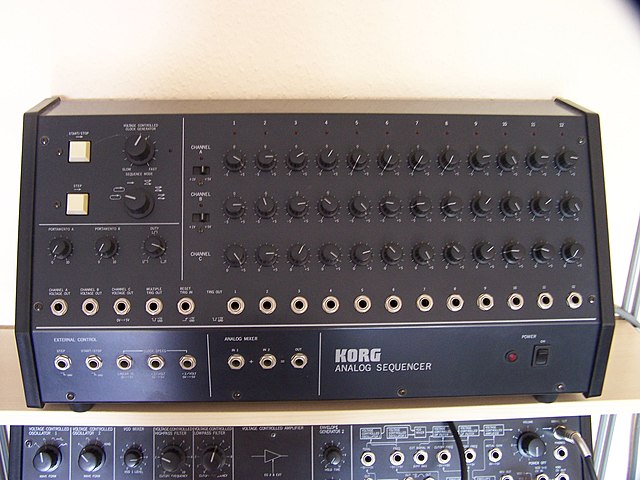
A synthesizer sequencer is a feature in many synthesizers that allows the user to record and playback a sequence of notes and other events. A sequencer essentially acts as a musical “memory” for the synthesizer, allowing the user to record and playback performance.

Sequencers can be used to record a melody or a chord progression, for example, and play it back repeatedly. The user can input the sequencer’s notes and other parameters such as velocity, pitch bend, modulation, and other CCs (Control Changes). Some sequencers also include editing capabilities such as quantization, transposition, and adding or removing notes from the sequence.

There are different types of sequencers; some are simpler and record the notes, while others have more advanced features, such as the ability to record multiple tracks and create complex arrangements. Some sequencers also can sync with external devices such as drum machines or other electronic instruments, allowing the user to create a cohesive and tight performance with multiple instruments.

Synthesizer sequencers can be a powerful tool for music production, allowing the user to quickly and easily record and play back complex performances, and create intricate, layered compositions.

Categories
Synthesizer Features

Modulation

In a synthesizer, modulation refers to using one signal to control or change another signal. To do this, a signal called the modulator can be routed to control a signal called the carrier’s parameter. An LFO or an envelope generator, which generates a control signal that can be used to modulate different sound parameters, serves as the modulator in most cases.

In synthesizers, the following modulation types are most frequently used:

  • Amplitude modulation: This involves using an LFO or envelope generator to modulate a sound’s amplitude (i.e., the loudness). This can create effects like tremolo (a modulation of the amplitude at a low frequency) or envelope-controlled volume changes.
  • Frequency modulation (FM): This involves using one oscillator (the modulator) to modulate the frequency of another oscillator (the carrier). This creates complex, harmonically rich timbres and can create a wide range of sounds, from bell-like tones to metallic and percussive sounds.
  • Phase modulation (PM): This is similar to FM, but instead of modulating the frequency of the carrier, it modulates its phase. The result is a more subtle, detuned effect that can create chorus, flanger, and phaser effects.
  • Pulse width modulation (PWM): This involves modulating the width of the pulse waveform of an oscillator. This creates a variation in the harmonic content of the sound and can be used to create a wide range of timbres.
  • Filter modulation: This involves modulating the cutoff frequency of a filter to create effects like filter sweep and envelope-controlled filtering.

These are only a few applications for modulation in the shaping and sculpting of synthesizer sounds. Modulation is a primary factor that makes synthesizers such potent and versatile instruments, and the possibilities are essentially endless.

Categories
Synthesizer Features

LFOs

A synthesizer LFOs is a modulation source that can give a sound motion and variation. When applied to a sound, an LFO modulates one or more sound parameters, such as pitch, amplitude, or filter cutoff. The LFO produces a repeating waveform at a low frequency, typically below 20 Hz, such as a sine wave, triangle wave, or square wave. Since this low frequency is below the threshold of human hearing, the LFO’s modulation effect is not directly audible; instead, it produces subtle sonic variations.

A vibrato effect, for instance, is produced when an LFO is applied to the pitch of a sound. This is a result of the LFO’s low-frequency, up-and-down pitch modulation. Similarly, a tremolo effect is produced when an LFO is applied to the sound’s amplitude. This is a result of the LFO’s low-frequency, up-and-down volume modulation.

Additionally, LFOs can be used to modulate other parameters, such as the filter’s cutoff, to produce phasing effects or even to modulate additional LFOs to build intricate modulation chains. LFOs are a potent tool for sculpting and sculpting sound in a synthesizer, and the possibilities are endless.

LFOs typically have several adjustable parameters, including frequency, waveform, depth, and delay. These controls can alter how the LFO affects the sound and produce a wide variety of textures and timbres.

Categories
Synthesizer Features

ADSR Envelopes

An envelope in a synthesizer is a control signal that modifies a sound’s amplitude and other properties over time. Attack, Decay, Sustain, and Release are its four main parameters (often abbreviated as ADSR).

  1. Attack: controls the time it takes for the sound to reach its maximum amplitude after a note is played.
  2. Decay: controls the time it takes for the sound to decrease from its maximum amplitude to the sustain level.
  3. Sustain: controls the level of the sound while the note is held.
  4. Release: controls the time it takes for the sound to decrease from the sustain level to silence after the note is released.

Subtractive synthesis relies heavily on envelopes, frequently used in sample-based, FM, and physical modeling synthesis techniques.

An envelope in a synthesizer is a control signal that gradually alters a sound’s amplitude and other properties. Attack, Decay, Sustain, and Release are its four primary parameters. By shaping the amplitude and other parameters like the filter cutoff frequency, pitch, and others, these parameters can control how the sound changes over time. To produce dynamic and expressive sounds, they can also be modulated by other synthesizer elements, such as LFOs and velocity. They are an essential component of subtractive synthesis and are frequently applied to other synthesis techniques.

Categories
Synthesizer Features

Filters

In a synthesizer, a filter is a device or circuit that alters the frequency content of a sound signal. The user can sculpt and shape the sound by removing or decreasing particular frequencies or harmonics. A synthesizer can employ a variety of filter types, each of which has unique qualities and tones.

  1. Low-pass filter: allows low frequencies to pass through while attenuating or cutting off higher frequencies. It produces a warm and mellow sound, and is often used to create a sense of depth and richness in the sound.
  2. High-pass filter: allows high frequencies to pass through while attenuating or cutting off lower frequencies. It produces a sharp and bright sound, and is often used to create a sense of clarity and definition in the sound.
  3. Band-pass filter: allows a specific range of frequencies to pass through while attenuating or cutting off frequencies outside of that range. It produces a resonant and nasal sound, and is often used to create a sense of focus and emphasis in the sound.
  4. Band-stop filter: also known as a notch filter, it reduces or eliminate a specific range of frequencies, it’s often used to remove unwanted resonances or to create a hollow and thin sound.
  5. State Variable filter: it’s a type of filter that provides different types of filtering (low-pass, high-pass, band-pass and band-stop) in the same module.

In a nutshell, a filter in a synthesizer is a component or circuit that modifies a sound signal’s frequency content. It enables the user to sculpt and shape the sound by removing or reducing particular frequencies or harmonics. A synthesizer can employ a variety of filter types, each of which has unique qualities and tones. Band-pass, Band-stop, Low-pass, High-pass, and State a kind of filter that can be applied to a synthesizer is a variable filter. Additionally, they can be modulated by other synthesizer components to produce dynamic and changing sounds.

Categories
Synthesizer Features

Oscillators

An oscillator is a core component of a synthesizer that generates a repeating waveform, which is used as the building block for creating sound. A sine wave, square wave, sawtooth wave, triangle wave, or another type of waveform can be produced by an oscillator. An oscillator’s frequency, which is typically measured in hertz, determines the pitch of the waveform it produces (Hz).

Oscillators are a vital component of a synthesizer because they supply the unprocessed audio that other features, like filters, envelopes, and LFOs, use to shape and process the audio. Most synthesizers have multiple oscillators, which can be used to layer or modulate various waveforms to produce complex sounds.

Various parameters can also control a synthesizer’s oscillators, including waveform, tuning, detuning, pitch modulation, sync, and others. Different oscillators, including wavetable and sample-based oscillators and analog and digital oscillators, are also found in some synthesizers.

In conclusion, a synthesizer’s oscillator is a component that produces a repeating waveform, which is the basic building block for creating sound. Most synthesizers have multiple oscillators to build more complex sounds, and oscillators can have various parameters that let the user shape and modulate the sound.

Synthesizer Waveforms

Synthesizers use various types of waveforms to generate sound. Some of the most common waveforms used include:

  1. Sine wave: a smooth, pure tone with no harmonics.
  2. Square wave: has a distinct “on-off” sound with sharp edges, and has odd harmonics.
  3. Sawtooth wave: has a bright, brassy sound, with even and odd harmonics.
  4. Triangle wave: similar to a sawtooth wave, but with a softer attack and fewer harmonics.
  5. Pulse wave: similar to a square wave, but with a variable duty cycle (the width of the “on” state in relation to the total period of the waveform)
  6. Noise: random electrical signal, can be white, pink or other colors.
  7. Super Saw: a waveform that is a combination of multiple sawtooth waves detuned from each other.
  8. Feedback Oscillator: a waveform generated by sending the output of an oscillator back into its input, creating a complex and evolving sound.
  9. Sample-based waveforms: a recorded sample of a sound can be used as a waveform.
  10. Wavetable synthesis: a method where a synthesizer uses a table of pre-recorded waveforms to generate new sounds.

Synthesizers can also use combinations of these waveforms and modulate them to create more complex sounds.