
Categories
Sound Design and Production Concepts Synthesizer Concepts

Phase Distortion Synthesis (PDS)

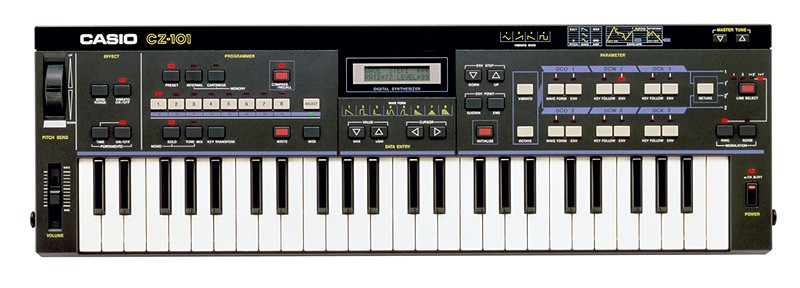
Phase Distortion Synthesis (PDS) is a technique for creating sounds that are used in creating electronic music, particularly in the mid-1980s Casio CZ synthesizers. The method, which is based on changing a waveform‘s phase, gives users more control over a sound’s harmonic composition. This makes it possible to produce a wider variety of sounds than traditional subtractive synthesis.

By changing the phase of a fundamental waveform, typically a sine wave, PDS produces sound by generating a new waveform with new harmonic content. Complex sounds that would be challenging or impossible to create using conventional subtractive synthesis can be produced by manipulating the waveform’s phase.

One of PDS’s main benefits is that it makes it possible to produce sounds with a variety of harmonic content. Bass, leads, and percussive sounds can all be produced this way. Additionally, it enables the production of intricate and changing sounds that are challenging to achieve using conventional subtractive synthesis.

PDS also offers extensive control over a sound’s harmonic composition, which can be used to produce unusual and distinctive sounds. This has led to it becoming a well-liked option for musicians and producers looking to incorporate unique and distinctive sounds into their music.

In general, phase distortion synthesis is a robust and adaptable method of sound creation that can create a variety of sounds. It has become a popular option among musicians and producers looking to produce distinctive and one-of-a-kind sounds. It is still used today in many types of electronic music production.

Categories
Synthesizer Features

Frequency Modulation (FM) Synthesizer

An FM (Frequency Modulation) synthesizer is a type of synthesizer that creates sound by modulating the frequency of one oscillator (the carrier) with the output of another oscillator (the modulator). This creates complex, harmonically rich timbres and can be used to create a wide range of sounds, from bell-like tones to metallic and percussive sounds.

In an FM synthesizer, the carrier oscillator generates the basic sound, and the modulator oscillator modifies the frequency of the carrier. The amount of modulation, or the “index” is controlled by the operator, and it determines the amount of harmonic complexity added to the sound. FM synthesis can produce a wide range of sounds, from simple sine waves to complex, evolving timbres.

FM synthesis was first developed by John Chowning in the 1970s, and it was later implemented in commercial synthesizers by Yamaha in the early 1980s. Since then, FM synthesis has been used in a wide variety of music genres, from electronic and pop to jazz and classical.

FM synthesis is known for its ability to create a wide range of sounds, from simple sine waves to complex, evolving timbres. It’s particularly good at creating bell-like, metallic and percussive sounds. FM synthesis can be a little bit more complex to use than other types of synthesis, but it is a very powerful and versatile technique, and it can be used to create a wide range of interesting and unique sounds.

Examples

  • Yamaha DX7: One of the most famous and widely used FM synthesizers, the DX7 was released in 1983 and it was known for its ability to create a wide range of sounds, including bell-like, metallic and percussive sounds. It became very popular in the 1980s, and it was used in a wide variety of music genres.
  • Yamaha DX9: An improved version of the DX7, the DX9 was released in 1985. It offered more features and capabilities than the DX7, including the ability to create more complex sounds.
  • Yamaha DX21: A more affordable version of the DX7, the DX21 was released in 1985. It has a similar sound engine to the DX7 but with a more limited set of features.
  • Korg DS-8: A digital FM synthesizer released by Korg in 1986, the DS-8 was known for its ability to create a wide range of sounds and its user-friendly interface.
  • Casio CZ-series: Casio released a series of affordable and compact FM synthesizers in the 1980s, which were known for their ability to create complex, evolving sounds.
  • Native Instruments FM8: A software FM synthesizer, FM8 is known for its ability to create a wide range of sounds and its user-friendly interface. It also allows for complex modulation and a wide range of presets.