
Categories
Classic Synthesizers Synthesizer Models

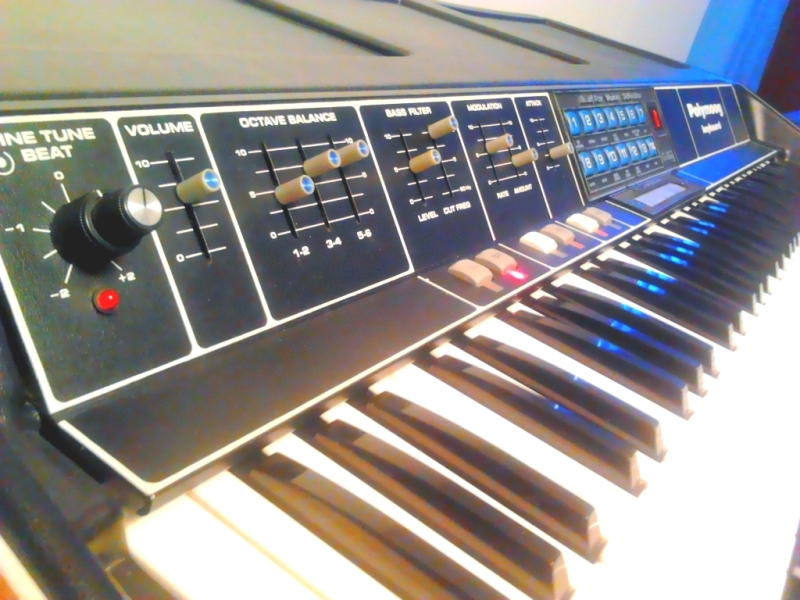
Moog Polymoog

The Polymoog is a polyphonic analog synthesizer manufactured by Moog Music in the 1970s. It was one of the first polyphonic synthesizers available to musicians and was known for its rich, expressive sound and versatility.

The Polymoog was first introduced in 1975 as a follow-up to the popular Minimoog monophonic synthesizer. The Polymoog featured a 71-note weighted keyboard and was capable of producing up to six voices simultaneously, making it a popular choice for musicians who wanted to add a more complex and dynamic sound to their music.

One of the key features of the Polymoog was its use of filtering, which allowed users to shape the synth’s sound in various ways. The synth featured a 24dB/octave resonant low-pass filter, which could be used to create a wide range of sounds, from subtle to extreme. Additionally, the Polymoog featured a 3-band equalizer, which allowed users to adjust the balance of bass, midrange, and treble frequencies.

The Polymoog also featured a variety of modulation sources, including an LFO, a sample-and-hold generator, and an envelope generator. These tools allowed users to add movement and variation to their sounds, creating a wide range of textures and effects.
The Polymoog’s sound generation was based on subtractive synthesis and featured a voltage-controlled oscillator. The Polymoog also featured a noise generator, which could be used to add percussive or other natural sounds to the synth’s sound palette.

Despite its popularity, the Polymoog was in production for only a few years, and production was halted in 1980. However, the Polymoog has become a cult classic and is still highly sought-after by synth enthusiasts today. Its rich, expressive sound and versatility make it a popular choice for musicians looking to add a unique and dynamic sound to their music.

Used by:

Categories
Classic Synthesizers Synthesizer Models

Ensoniq ESQ-1

The Ensoniq ESQ-1 is a digital synthesizer that was first introduced in 1986. Ensoniq, an American company well-known for its electronic musical instruments, created and produced them. In the latter half of the 1980s and the beginning of the 1990s, producers and musicians frequently used the ESQ-1, and synth fans still covet it today.

The hybrid synthesis engine of the ESQ-1 is one of its fundamental characteristics. Because it combines the capabilities of digital and analog synthesis, a variety of sounds and textures are possible. The ESQ-1 comes with a library of pre-recorded samples that can be used to create sounds. The digital side of the synthesis engine is based on samples. Subtractive synthesis, which uses filters to shape and sculpt sounds, is the foundation of the analog side of the synthesis engine.

A strong sequencer included with the ESQ-1 enables users to construct intricate and complex compositions. The sequencer has numerous editing options and can hold up to 100,000 notes. Additionally, it has an integrated drum machine, which is excellent for making beats and rhythm tracks.

The ESQ-1 has a modern, straightforward user interface that is simple to use. It has a sizable LCD screen that shows all the crucial details, such as the settings for each parameter and the current patch. The keyboard has 61 velocity-sensitive keys, and the aftertouch feature on the instrument enables even more expressive playing.

The ESQ-1’s capacity to store and recall patches is among its most notable features. Users can save and load patches to and from external storage devices, and the instrument can store up to 64 patches in its internal memory.

In conclusion, the Ensoniq ESQ-1 is a traditional digital synthesizer that has withstood the test of time. It is a flexible instrument that can produce a wide variety of sounds and textures thanks to its hybrid synthesis engine and powerful sequencer. It’s a fantastic studio and live-use option due to its user-friendly interface and capacity for storing and recalling patches. The instrument is still highly sought after by collectors and synth enthusiasts.

Used by

Categories
Classic Synthesizers Synthesizer Models

Roland D-50

The Roland D-50 is a digital synthesizer that was first released in 1987. It is renowned for its distinctive sound, which combines real instrument samples with sound synthesis techniques to produce a fresh, hybrid sound.

The D-50 uses “Linear Arithmetic” synthesis, a technique that combines sample-based synthesis with the conventional subtractive synthesis method, making it one of its standout features. This makes it possible to have more control over the instrument’s timbre and a wider variety of sounds.

The D-50’s extensive use of presets is yet another standout feature. The instrument includes a wide range of pre-programmed sounds, such as accurate piano and string sounds and more experimental and abstract sounds. Because of this, even new users can quickly produce complex music that sounds professional.

Despite its age, the D-50 is still a preferred option for producers and musicians. Its unique sound has been featured on countless recordings and is still used in a wide range of genres, such as electronic, pop, and film scores.

The D-50’s lack of MIDI support is one drawback; it was introduced before MIDI became a standard, making it challenging to integrate with contemporary production environments. However, a MIDI retrofit or converter can be used to get around this.

Overall, the Roland D-50 is a legendary and classic synthesizer that is still highly sought after for its distinctive and adaptable sound. The D-50 is certain to spark creativity and give your music a fresh perspective, whether you’re a seasoned pro or just getting started.

Used by

Categories
Classic Synthesizers

Moog Minimoog

Robert Moog originally unveiled the iconic analog synthesizer known as the Moog Minimoog in 1970. It was one of the first portable synthesizers. It quickly established itself as a standard in the music business, being utilized by a variety of musicians in the rock, pop, and electronic music genres.

The Minimoog’s use of oscillators to produce sound is one of its distinguishing characteristics. A wide range of tone possibilities and the capacity to create complex sounds are made possible by the instrument’s three voltage-controlled oscillators. A low-pass filter is also included, which can be used to sculpt the sound and give warmth and depth.

The Minimoog’s interface was also straightforward and user-friendly, making it easier for musicians to produce new sounds swiftly. The oscillators, filter, and modulation may all be adjusted with the knobs on the front panel. A keyboard is also included for playing sounds. The synthesizer became more widely used because of its layout, making it affordable for musicians of all levels.

The Minimoog was renowned for being portable since it was tiny enough to be carried around easily but still provided a variety of sound-shaping choices. It became popular among traveling artists, and renowned bands like Pink Floyd, Tangerine Dream, and many others have used it in their stage settings.

The Minimoog was used in popular music and soundtracks for movies and television shows, especially in the 1970s and 1980s. It was the ideal instrument for bringing depth and emotion to a scene because of its rich, powerful sound.

Even though it wasn’t manufactured after 1981, the Minimoog is still a very popular instrument, with original examples fetching high sums on the vintage market. Moog Music relaunched the Minimoog in 2002 with enhanced features like MIDI and a bigger keyboard, and synth enthusiasts continue to favor it.

The Moog Minimoog is a true classic in analog synthesizers due to its warm and powerful sound, user-friendly design, and portability. Numerous well-known bands’ music shows its impact, and its legacy motivates new musical generations.

Used by