
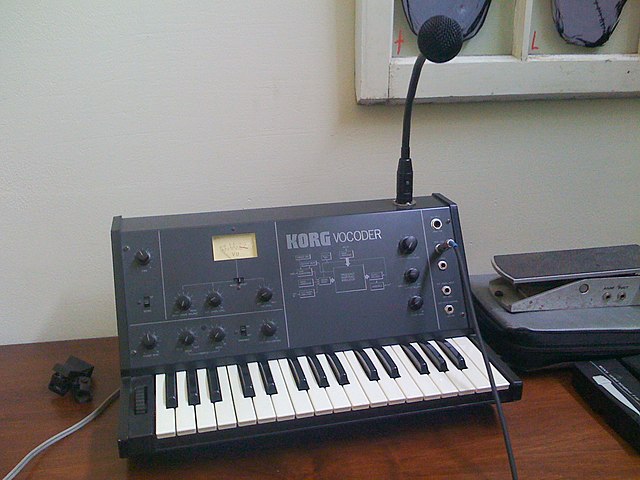
A synthesizer vocoder is a device that combines the sounds of two different signals, a modulator, and a carrier, to create a new, unique sound. The carrier signal is typically a synthesized sound, like a sawtooth or square wave, while the modulator signal generally is an audio recording of a human voice. The vocoder modifies the frequency content of the carrier signal by studying the modulator signal’s frequency content. The end result is a sound that combines the modulator signal’s timbre and intonation with the carrier signal’s harmonic content.
A bank of bandpass filters divides the modulator signal into various frequency bands, producing the vocoder effect. The amplitude of each frequency band then controls the carrier signal’s amplitude. This gives the impression that the words or sounds coming from the modulator signal are being “spoken” by the carrier signal.
The 1930s saw the introduction of the vocoder effect, initially used to compress speech but quickly made its way into music. It gained popularity in the 1970s thanks to the use of robotic and futuristic vocal effects by bands like Kraftwerk and ELO. Vocoders are still frequently used to produce distinctive vocal effects in electronic, pop, and hip-hop music today.
Some synthesizers come with a built-in vocoder, while others can be used to add the vocoder effect using an external microphone. The vocoder can be a potent tool for producing distinctive and intriguing sounds, adding a fresh perspective to the music-making process.
 Synthesizer Online